
The “Reluctant” Prophet
Reader Beth asked, “Why reluctant?”
Anyone who knows me well knows that I tend to be a pretty nice guy. In fact, probably overly nice. I could give you a whole summary of my therapy sessions around that, but I will leave that to a later time. It will show up in my book for sure.

Photo by Julia Taubitz@justmejuliee
I think I can cut to the chase on this one. The truth is I completely read the culture of church wrong during my years of education and the early years in the professional ministry. I know many of you will read what follows and wonder how I could be so naive. But it is what it is. I was completely naive about the difference in environments between the college and seminary and the local church.
I know what I got wrong and I know why I got it wrong. Because of the pretty severe emotional neglect of my childhood I entered into adulthood with a deep drive to prove myself worthy of love and respect in my educational and work endeavors. For most of the semesters of my education I was able to hold straight A’s. At a couple of points professors complimented me and encouraged me for work that was clearly beyond just doing the assignment. I was told that not only was I understanding the theology that I was reading, but that I was going beyond and thinking theologically on my own.
This especially showed up in my honors’ thesis in college on “The Protestant Response to the Holocaust” and then my research in seminary on both the Jewish and Christian theology that emerged after the Holocaust.
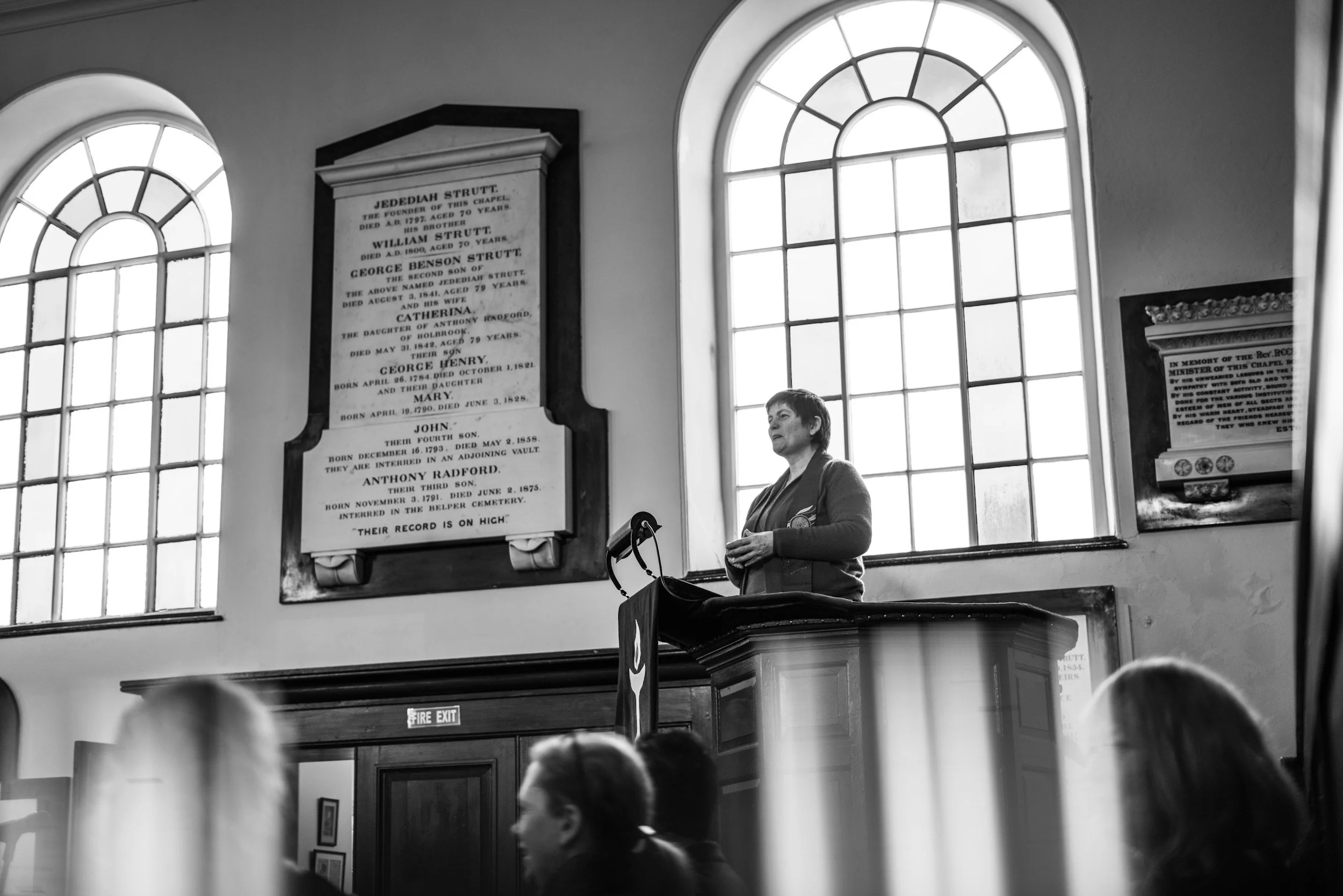
Photo by Belper Unitarians@belperunitarians
Although I didn’t initially intend to become a pastor, toward the end of my seminary education it occurred to me that the best place to continue this theological thinking and exploration would be from the pulpit every Sunday. The idea that a church would pay me to read and think all week and then offer them the best of my thinking for twenty minutes every Sunday was like a dream come true. It felt like the natural progression from seminary to ministry.
But I had made an assumption and it was the wrong assumption. Years later when I began reflecting on what went wrong, I came up with an analogy that explained my experience. The assumption that I had made was that the church was just like the medical field. If a doctor graduates at the head of their class and is known for their groundbreaking procedures and advances in diagnoses, hospitals will seek them out for that very reason.
I am not saying that I graduated at the top of my class, although I was certainly in the top few. What I do know for sure is that the more I dove into the essence of the Christian tradition and its theology, the more I was rewarded with both grades and encouragement.

Photo by Gaman Alice@gamanalice3012
I know some of you are reading this and thinking to yourself, “I know where this is going and I can’t believe Brian was so naive.” But I was shocked when I entered the professional ministry and discovered the more I preached cutting edge theology the more the congregations felt threatened by me. I honestly thought that congregations wanted the best and most recent theology coming out of our seminaries in the same way that a hospital would want their doctors to be up on the most recent research and procedures.
I was wrong.
But it didn’t keep me from continuing to preach and teach the best of what I knew. I went into the ministry thinking that if I gave them the best of what I knew, the best of my thinking, the most cutting edge theology that the church would treat me the same way that my professors did. They would offer their gratitude in the same way that the seminary offered its encouragement and rewarded me with good grades.
Why “reluctant.” Because I never wanted to be prophetic. I just wanted to be liked. But I am who I am. Despite congregations’ hesitancy and resistance to the most recent theological thinking, I found I couldn’t back off. I expected my preaching and teaching to be appreciated for its cutting edge thinking. Instead it was experienced more as uncomfortably prophetic. Here is what I know: I didn’t have the emotional maturity to see the difference between the seminary and the church in my early years. But, at the same time it exposed something—seminaries and churches were out of alignment. I thrived in the seminary culture. I struggled in the congregational culture.
I can’t be anything other than I am. But I never sought out a prophetic role. I just wanted to be liked. And I thought the harder I worked, the deeper I went, and the more insightful I was, the more I would be appreciated and liked.
I was wrong. But I am okay with that now. Therapy can do wonders!
Question for the Dialogue (you can comment at the bottom of the post from the orignial post link):
Do you think seminaries need to do a better job adapting to the realities of the local congregation or do local congregations need to be encouraged to make more room for the theology being taught at seminaries?