
The Reluctant Prophet: The Universal Church?
Reader Suzan posted, “My first question is should we think of (the church’s) legacy as belonging to the church universal or individual congregations.”
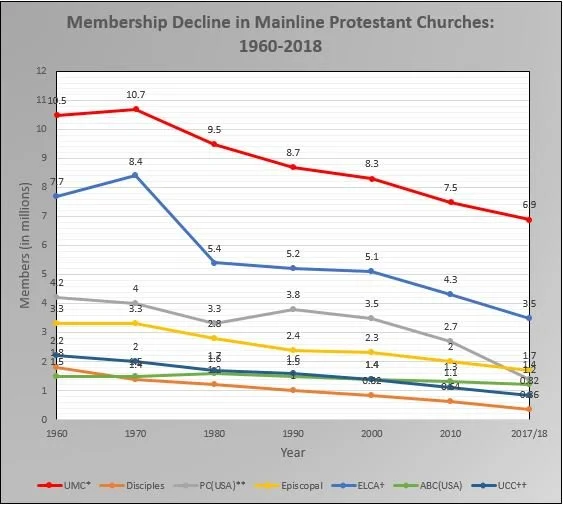
She first acknowledged that we are in a time when the mainline Protestant church should be focused on its legacy given the nearly sixty straight years of membership and attendance decline. Churches in our tradition continue to talk about and hope for growth despite the evidence that these denominations are rapidly dissolving away.
In grief theory we would say that this represents a heavy dose of denial. However, most of my experience was that churches were largely in the third stage of grief—that is, bargaining. This looked like churches trying all kinds of new things to see if they could reverse the trend of decline only to discover that their attempts were like doing a facelift on an aging body.
But Suzan asks, “Will the resulting legacy be part of the church universal or individual congregations?”
My first response to this question is, “We don’t really know.” Having said that it is important to say that there shouldn't be an expectation that it will show up in individual congregations. This is important because this is one of the concerns that keeps congregations from doing legacy planning. They want to hold onto their congregation or at least know that what comes next will still look like a community of people gathered in a church building. Those of us who grew up in the church can’t even imagine what a church looks like without a building. And, if such a group exists we tend to automatically ask, “Well then, is it even a church?”
The truth is maybe the legacy of the church and the Christian tradition will eventually show up in the form of individual congregations. But it will be critically important to let go of that expectation so that the water of this shift has the freedom to flow wherever it needs to flow.
Photo by Guneet Jasaal@guneet
I like Suzan’s reminder of the “church universal” even as I offer an important caution. The language of the “church universal” is Christian language. For Christians I think this language expands the conversation dramatically in a way that loosens the system up to discovering new forms of spiritual community and practice. But we need to remember that even with such a word as “universal” the concept may be too limited for the reformation/revolution that is emerging. The universal church basically just refers to all Christians or followers of Jesus throughout the world and in history. Sometimes it is called the “invisible church”—that is, all who belong to the Kingdom of God.
But there are two limitations to this language. One, is that most interpretations do limit this to those who claim Jesus as their savior or, at the minimum, base their lives on his life and teachings. The second limitation is that while the language may expand a Christian’s worldview in such a way as to open them up to new forms of spiritual community, the language will still be too limiting for those who might call themselves “spiritual but not religious.” The language of the Universal Church still refers to “church” which will be a barrier to finding common ground for many.

Photo by Sumit Bisht@adiyogpeeth
My experience of people who have a deep spiritual life and practice, but who are outside the boundaries of traditional church talk of wanting community, authenticity, a place to serve, grow and learn, and feel a connection to the Sacred. All of that probably sounds like church to a church-gong person, but the word church will immediately bring up images for many of a building where exclusion, rigid thinking, and judgment prevail.
The other thing that should be assumed is this—whatever the future holds it will probably be less based on religious belief and more based on spiritual experience. If the Universal Church includes those who embody the values of Jesus Christ even if they don’t claim the name of Christian, there is hope for a legacy that will still be Christ-centered, but not necessarily Christ-focused.
This will be the challenge.
Question for Dialogue: Can the Church, as it is, turn its tradition over to people, organizations and communities that will continue to carry out Christ’s work even if they don’t claim Christ’s name?