
“Whenever we look into the face of an enemy, we see ourselves.”
Howard Thurman

Photo by Brock Wegner@isthatbrock
In all of my years as an engaged citizen in these United States, this last decade has been the closest to feeling like those with whom I disagree are enemies. I still think back to the time represented by the story of Democratic Speaker of the House, Tip O’Neill, and Republican President, Ronald Reagan. The story goes that the two would disagree vehemently in meetings and on the floor of the House, but in the evenings retire to a bar to share Irish Whiskey.
It was a time when most of us felt that we could disagree on the issues while remaining united in our common love of the country. But, now the rhetoric has escalated to the point where disagreement is not just a matter of a different perspective; it is a matter of who are considered true Americans and who have betrayed our country. We no longer speak of differences as being part of a healthy democratic dialogue. Now we speak as if we are at war with each other with enemies as close as next door or blood relatives.
Howard Thurman, a philosopher, theologian, mystic and civil rights activist, speaks a psychological and spiritual truth that may help us move through this time with hope for a restored future. But it will require a self-honesty that quite honestly will make most of us uncomfortably squirm.
Thurman reminds us enemies are not separate from us, but are rather projections of our own internal reality. A projection is when someone assumes somebody is something because of unresolved issues in their own lives. As a pastor I experienced this a lot. I was often a stand in for absent fathers. Members projected onto me the needs they had whether or not I could actually fulfill them.

Photo by Erwin Bosman@erwinbosman
I am reminded that when we speak the language of “enemies” we are not speaking about a certain class of people or a group of people with certain skills or characteristics like plumbers, teachers, managers, and baristas. There is no agreed upon group that fits the definition of enemies. You can’t google “enemies” and get a list handed to you. Enemies are always relative to something, whether to a particular group or to a set of values.
We have to remember that if we have enemies we can be pretty confident that we are also their list as an enemy as well. There are no universally agreed upon good guys and bad guys. In the old days the Indians were the bad guys and white settlers were the good guys. These days, for many people, those roles have now reversed.
An enemy is simply the projection of our fears of a threat to our self-interest or worldview. The opposite is also true. An ally is simply a projection of our hopes of support for our self-interest or worldview. There are no actual enemies and allies. There are only projections of our own self-interest that we conveniently assign to the people in our lives. Even in disagreement and war we are not enemies. We are human beings, brothers and sisters, tearing at each other.
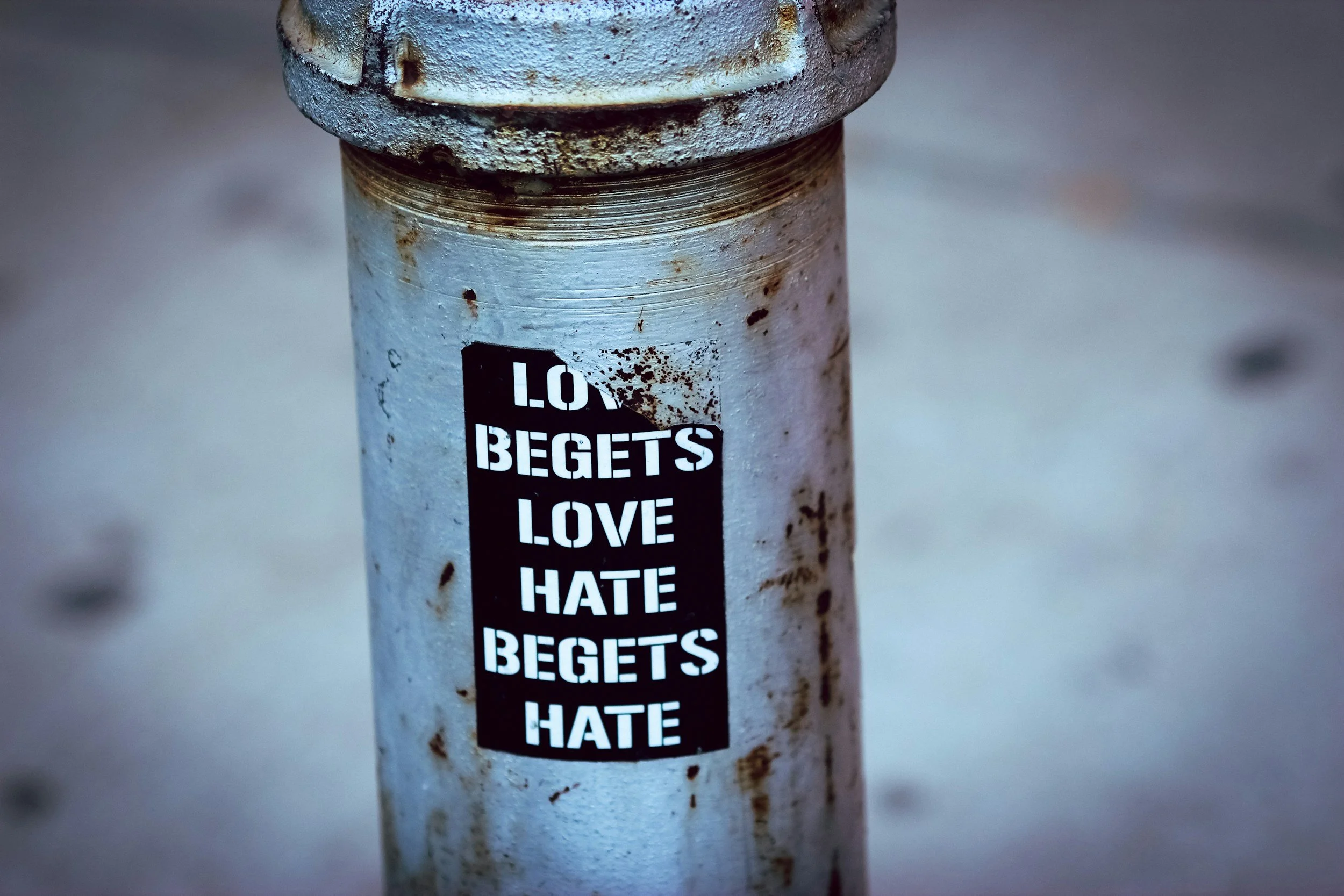
Photo by Jon Tyson@jontyson
I actually believe that when Jesus said, “Love your enemies” he wasn’t saying it to create better social harmony (although that would be a likely outcome). He was saying it so that each of us would become more whole, more integrated, and reflect the character of God more closely. He was saying it so that rather than “othering” other people, we would actually learn to love the ugly and shameful parts of our own lives.
When I was in Bali I remembered asking our driver why all of the curbs were painted in alternating strips of about six feet of black and white. The driver told me, “It is the government’s way of reminding us that each of us must choose every day between good and evil.” The Hindu assumption was not that some people are good and others are bad. It was that all of us as creatures of God have the capacity for good or evil. No one is completely good or bad. All of us are complex stew of good and evil.
These days we have tended toward black and white thinking—“we are good and they are bad” whoever the we and the they are. The days of drinking an Irish Whiskey after a robust political argument feels like a fading memory.
I know this is going to feel like a big ask, but I do believe this: The task before us now in these United States is to see ourselves in those we are calling enemies and to heal the divide within our own hearts and souls before trying to silence or kill in others what we don’t like in ourselves. Enemies are projections of what we don’t like in ourselves.
“Whenever we look into the face of an enemy, we see ourselves” says Howard Thurman. The easy way out is to split the world into good guys and bad guys, allies and enemies. The harder work is to recognize that the enemy out there is actually a projection of the enemy inside us that we haven’t yet made peace with.